
For her, this comes as no surprise. “Even during the European Parliament inquiry, national governments refused to cooperate. Their position was: this is a matter of national security, it has nothing to do with the European Union, let alone the European Parliament. All governments defended what they see as their prerogative: whether or not to use spyware.” Her assessment of the European Commission is blunt: “It was weak and cowardly. It sided with national governments and refused to act.”
Half-victories
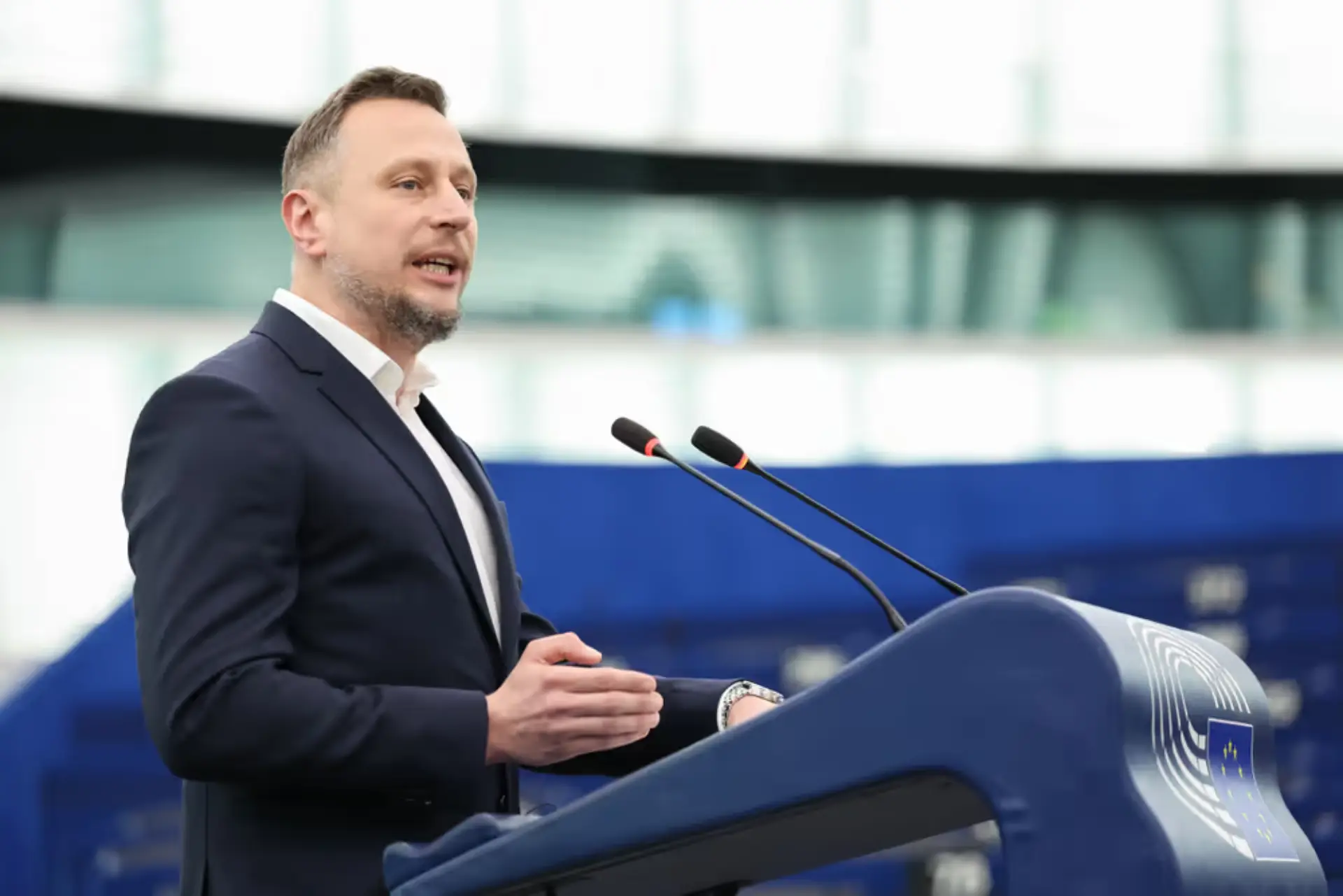
“The system is not designed to help victims: there is no transparency and there are no clear procedures,” says Krzysztof Brejza, a Polish member of the European Parliament from the European People’s Party group.
Brejza experienced this himself. When his phone was infected with Pegasus, he was running the election campaign against Law and Justice, then Poland’s ruling party.
“They gained access to 85,000 messages, covering the last ten years of my private and professional life. Because they found nothing against me, they went further and manipulated my conversations. Altered exchanges were broadcast by national television to discredit me. The aim was to interfere in the election by weakening democracy,” Brejza tells IrpiMedia.
The surveillance had been requested by Poland’s Central Anti-Corruption Bureau. For years, the operation was presented as legitimate because it was linked to an investigation into Brejza’s father over alleged irregularities in the administration of the municipality where he was mayor. However, an audit by prosecutors in Danzica later found the allegations to be unfounded and the investigation was dropped. “It was just a pretext to justify the surveillance,” Brejza says.
In October 2026, a parliamentary inquiry committee set up in Poland after Donald Tusk took office to investigate the use of Pegasus under the previous government concluded that the spyware had been purchased unlawfully and used against political opponents.
Yet Brejza’s only victories have come in civil court. The television broadcaster that aired the manipulated messages was ordered to apologize and pay him damages. The criminal investigations are still ongoing.
“In Poland, the justice minister is also the prosecutor general. Under the previous government, nothing moved. Now things are moving forward very slowly,” Brejza says.
Meanwhile, the former justice minister first obtained political asylum in Hungary and later moved to the United States.
In fact Koukakis, too, has achieved only partial justice since the court did not establish who ordered the surveillance.
“We documented the use of the weapon and identified the killer, but we still have not established who gave the order,” Koukakis says.
According to transcripts of the trial hearings reviewed by IrpiMedia, nearly one-third of the people targeted with Predator between 2020 and 2021 had also been subjected to traditional phone surveillance by the Greek intelligence services.
Koukakis does not believe the overlap was coincidental. “It was the same operation. To install the spyware on the phone, the victim had to click on a fake link. First they monitored us to understand our habits, and then they sent the lure messages,” he explains.
One former Facebook manager, for example, had booked a Covid-19 vaccination when she received a fake text message about the appointment. Koukakis, meanwhile, received messages inviting him to read articles.
According to Koukakis, an economic affairs journalist, the motive behind his surveillance may lie in investigations he carried out in 2020 for CNN Greece and the Financial Times into changes introduced by the Greek government to the criminal code and tax legislation that allegedly benefited people involved in financial crimes.
Yet Greek authorities continue to deny using Predator. “They do not want to admit it because at the time there was no law regulating its use, so it was illegal,” Koukakis says.
In its February 26 ruling, the Athens court of first instance referred the case files to prosecutors to investigate further responsibility and possible more serious offences, including espionage. But on April 27, the Supreme Court prosecutor decided not to reopen the investigation.
Koukakis challenged the decision and, last August, filed an application against Greece with the European Court of Human Rights, arguing that the country’s judicial authorities had failed to investigate the case thoroughly and impartially.
Sostienici e partecipa a MyIrpi
Regala l’adesione a MyIrpi+
e ricevi in omaggio la nostra T-shirt IrpiMedia.
Diventa una fonte.
Con IrpiLeaks puoi comunicare con noi in sicurezza.
“This legal battle requires an enormous investment of energy, time and money, including your own. You have to keep dealing with everyday life while also being present in court. It is like having to work 24 hours a day, seven days a week. That has been my reality for the past few years,” Koukakis says.
Information denied
For spyware victims, one of the main obstacles to seeking justice is the use of national security by state authorities to impose secrecy and avoid accountability. The European Parliament had recommended setting EU-wide limits on what can be justified on national security grounds.
State authorities should be required to demonstrate that surveillance is necessary, proportionate and lawful, and disclose their reasoning to a national oversight body. But the victims’ stories suggest otherwise.
“In 2021, analyses of my phone by Amnesty Security Lab and Citizen Lab proved that I had been spied on with Pegasus for seven months, between April and November 2019. The software downloaded and uploaded about 100 megabytes of data from and to my device. That is all I know,” says Szabolcs Panyi, a Hungarian investigative journalist who has long investigated Russian influence on the government of Viktor Orbán, the nationalist right-wing leader who governed Hungary from 2010 until May 2026.
The discovery had a profound impact on Panyi’s personal and professional life. Since then, with the support of the Hungarian Civil Liberties Union, he has been trying to get answers to some basic questions.

“All we have managed to find out is that the government’s civilian intelligence agency holds classified information about me. But we do not know what kind of data it is, when it was collected or how. Every request has been blocked on national security grounds,” Panyi explains.
“It is a terrible feeling to know that your own state considers you a national security risk and uses such an invasive tool against you.”
According to Panyi, Hungarian law is so permissive that “anyone can be spied on legally. Surveillance justified on national security grounds is authorized by the justice minister, who is a member of the government. Anyone targeted without justification has no remedy: precisely because everything is legal, we have very few ways to challenge what happened.”
Yet the same problem has also emerged in Spain and Italy.
Elena Jiménez, head of international and legal affairs at Òmnium Cultural, an organization that promotes Catalan language and culture and Catalonia’s right to self-determination, is unequivocal: “The problem in Spain was not the lack of an adequate legal framework. The laws are quite restrictive. To intercept communications, the Spanish intelligence service must obtain prior authorization from a Supreme Court judge.”
Those safeguards did not protect the phones of people linked to Òmnium Cultural from Pegasus. A Citizen Lab report published on April 18, 2022, documented spyware attacks against at least 65 people connected to the Catalan independence movement, almost all of them between 2017 and 2020. They included four members of Òmnium Cultural, including Jiménez.
The surveillance took place at a particularly sensitive moment. The organization’s then-president, Jordi Cuixart, had been placed in pre-trial detention on October 16, 2017, two weeks after Catalonia’s independence referendum, in which more than two million people took part despite its suspension by Spain’s Constitutional Court.
“So far, there has been almost no investigation. On the one hand, there is a lack of willingness from prosecutors, who have a duty to investigate. On the other hand, when they do try, they get no answers because everything is blocked by the state secrets law.”, Jiménez adds.
National security threats
In May 2022, the Defensor del Pueblo, Spain’s independent public authority responsible for protecting fundamental rights, found that Spanish intelligence services had placed 18 members of the Catalan independence movement under surveillance with judicial authorization. The list included Mauri and one other person from Òmnium Cultural.
But for Jiménez, surveillance is not necessarily legitimate simply because it has been authorized. “We are talking about spying on the vice president of a cultural organization. Simply invoking national security is not enough to make it lawful under international standards.”
“This is a serious case and it should make us all aware of one thing: not only right-wing governments, but progressive governments too can spy on citizens when they challenge their power. The surveillance exposed the legal strategy and the work of a civil society organization. It was an attack on our ability to exercise fundamental rights,” Jiménez concludes.
Across the Mediterranean, it was the Italian intelligence services carrying out the surveillance.
“I was classified as a national security threat. But why, and on the basis of what evidence?” asks Luca Casarini. An activist and co-founder of Mediterranea Saving Humans, an NGO involved in rescuing migrants in the Mediterranean, Casarini was placed under surveillance starting in 2019, along with Beppe Caccia, another founder of the organization.
Giorgia Meloni’s government later authorized the use of Graphite, Paragon’s spyware, against both of them. They discovered they had been targeted in January 2025 after receiving a notification from WhatsApp.

Intelligence activities targeting them had already begun under the second Conte government, backed by the Five Star Movement, the Democratic Party, Italia Viva and Free and Equal. They continued under Mario Draghi’s government and later under Meloni’s.
The official justification was suspected facilitation of irregular immigration into Italy.
Casarini, however, believes the real target was their collection of testimony and documents on crimes against migrants committed in Libya and Tunisia, and in particular abuses at Mitiga prison at the center of the allegations against Osama Almasri, a Libyan official wanted by the International Criminal Court for war crimes and crimes against humanity.
Almasri was arrested in Turin in January 2025, then released and flown back to Libya on an Italian state aircraft without being handed over to the Court.
Among those who have denounced his alleged responsibility is David Yambio, a Sudanese refugee and president of the Ngo Refugees in Libya, who was also targeted by Italian intelligence services.
Copasir, the parliamentary body that oversees Italy’s intelligence services, nevertheless concluded that the surveillance of Casarini, Caccia and Yambio was lawful and had been authorized by the Prosecutor General at the Rome Court of Appeal, as required by law.
“If spying on political activists for five years is lawful, then we are living in a police state,” Casarini counters, warning of “mass surveillance.”
In his office in Brussels, Wojciech Wiewiórowski, the European Data Protection Supervisor, keeps a book on his table: Ethics and the Future of Spying.
“As things stand, Europe still lacks the safeguards needed to ensure that spyware is used in a way that respects the privacy rights of those placed under surveillance, especially products like Pegasus, which are designed to exploit every technical possibility and collect as much information as possible,” Wiewiórowski tells IrpiMedia.
But he does not believe a moratorium would work. “EU member states will never give up these capabilities. We need to find a solution that combines European law with the decisions of member states.”
Koukakis is equally pragmatic.
“Spyware can be useful in addressing real threats, such as terrorism or crime. But we need tools that allow us to identify the end user of the product, so that, when necessary, we can trace who ordered the surveillance and who carried it out, even in real time,” the journalist tells IrpiMedia.
For Koukakis, that traceability should be “imposed at the European level.”
Rosita Rijtano is a 2026 Bertha Challenge Fellow. This investigation was carried out with the support of the Bertha Challenge Fellowship
Le inchieste e gli eventi di IrpiMedia sono anche su WhatsApp. Clicca qui per iscriverti e restare sempre aggiornat*. Ricordati di scegliere “Iscriviti” e di attivare le notifiche.