
13.10.25
Argomenti correlati
MigrazioniThe European Commission and Frontex will host a delegation of Libyan migration authorities from both the eastern and western parts of the country.
The mission is scheduled for October 14 in Warsaw — home to Frontex, the European Border and Coast Guard Agency — and for October 15 and 16 in Brussels, where the delegates will meet with officials from DG Home, the European Commission’s Directorate-General for Migration and Home Affairs. It is the first time that officials from Cyrenaica, the eastern region of Libya controlled by General Khalifa Haftar, have been invited to Frontex headquarters, and there are no public records of similar meetings with the Commission in Brussels.
The investigation in a nutshell
- From October 14 to 16, officials from Frontex and the European Commission’s Directorate-General for Migration and Home Affairs will meet with delegates from both eastern and western Libya in Warsaw and Brussels
- This is the first time that officials from eastern Libya — under the control of General Haftar — are visiting Frontex. There is also no public record of any prior visits by eastern Libyan representatives to Brussels
- Public officials involved in migration management have been invited to the meetings. The most well-known is the head of the delegation, who is the deputy to Interior Minister Emad Trabelsi. The two were once part of the same militia
- The announcement of these meetings comes shortly after Libyan authorities declared their intention to independently organize voluntary returns from detention centers under their control.
- Returns are also at the center of a series of meetings held in recent weeks by the EU Ambassador to Libya, Nicola Orlando. European representatives — both in Libya and elsewhere — are placing increasing emphasis on the return system, with new proposals that could potentially involve Frontex itself
Those invited include representatives of the Tripoli-based Government of National Unity (Gnu), recognized by the Un and the Eu, as well as members of the Libyan National Army (Lna) led by General Khalifa Haftar, who controls eastern Libya from Benghazi and has repeatedly clashed with Prime Minister Abdul Hamid Dbeibah’s Gnu.
Regarding the visit to Frontex headquarters, sources within the Tripoli Coast Guard confirmed the meeting and the presence, for the first time, of colleagues from the East. They interpret the encounter as an opportunity to get acquainted.
A delicate moment
From the perspective of international relations, the meeting comes at a sensitive time of intense diplomatic activity with both sides of Libya. In July, the authorities in Benghazi banned entry to the interior ministers of Italy, Greece, and Malta, as well as to the EU Commissioner for Home Affairs and Migration, Austrian Magnus Brunner.
It will be Brunner’s own staff who meet with the Libyan delegation in Brussels.
In fact, in an interview with POLITICO Europe, the Commissioner had already stated just a few days after the diplomatic incident: «We are, of course, ready to resume these talks at any time. In my view, this is urgently necessary». He added that “there are still technical-level communication channels that work very well,” referring to the talks between the Eu and officials representing Haftar.

The monthly newsletter with the latest surveys from IrpiMedia
Before the failed visit to Benghazi in July, the delegation of Eu, Italian, Maltese, and Greek officials had met with representatives of the Tripoli government, seeking more effective policies to curb migration flows toward Europe.
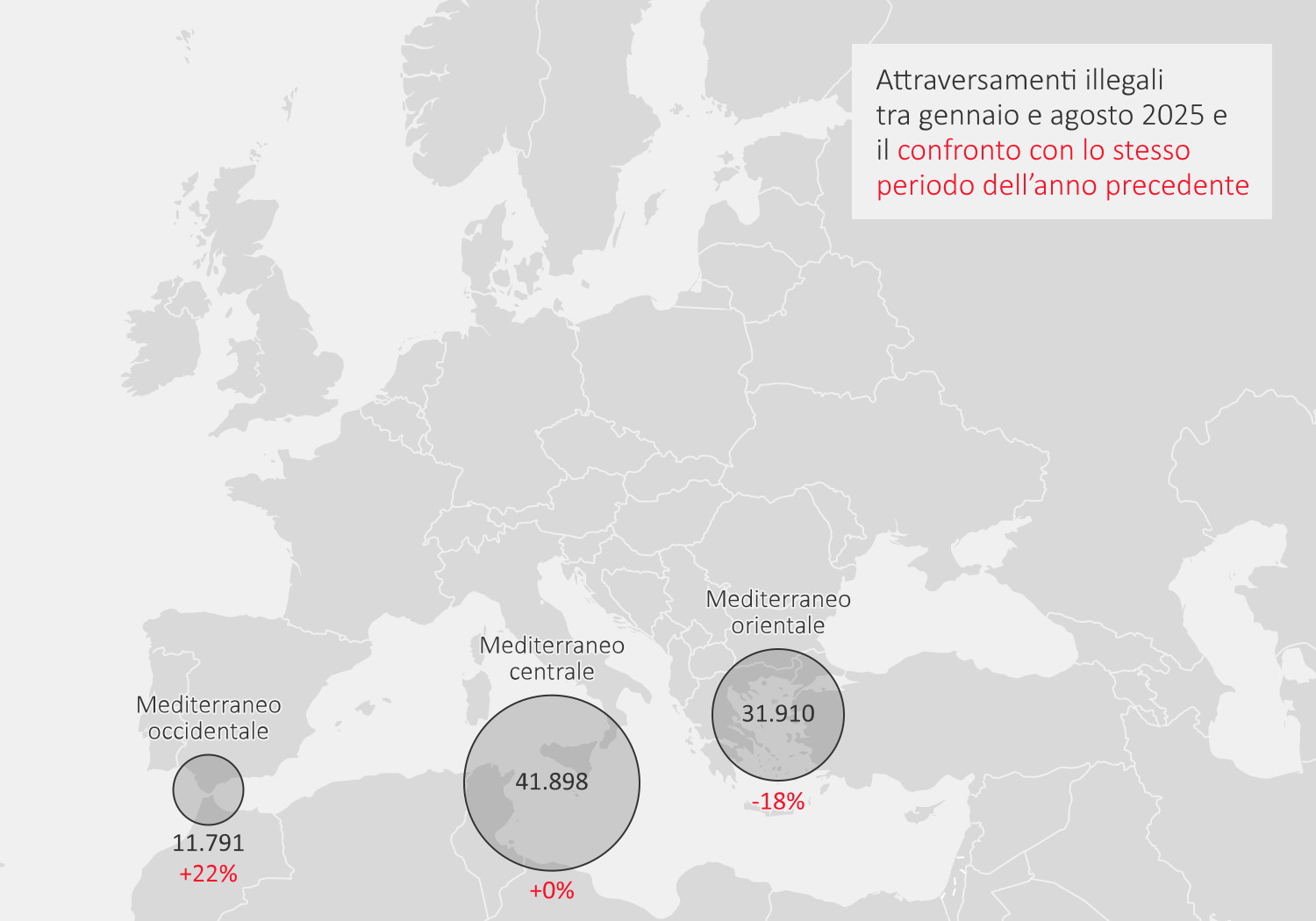
Despite an overall decrease in arrivals to the Eu, the latest data published by Frontex in September show that in 2025 the number of people arriving via the Central Mediterranean route has remained essentially unchanged from the previous year (around 41,000): «Libya,» the agency writes, «remains the main point of departure». Figures published by Agenzia Nova, updated in early October, show that arrivals from the North African country to Italy between January and early October have increased by 46 percent compared to the same period last year, and by 24 percent compared to 2023.
East and West together in Europe
According to the list of participants in the visits to Warsaw and Brussels, the western delegation includes eight officials from Tripoli’s Ministries of Interior and Foreign Affairs, the Libyan Coast Guard (Tripoli branch), and the General Administration for Coastal Security (known by its English acronym, Gacs). The eastern delegation, meanwhile, consists of six representatives from the Department for Combating Illegal Immigration within the Ministry of Interior, the Navy, and, as mentioned, the Libyan National Army (Lna).
In recent months, Tripoli’s coast guards have been involved in two particularly serious incidents. On August 25, a patrol boat fired for twenty minutes at the Ocean Viking, the Sos Méditerranée rescue vessel. The ngo described the episode as “a deliberate act of war” and estimated damages of €194,000 to the ship. On September 26, another ngo, Sea-Watch, reported that one of its boats was hit by gunfire after it failed to comply with an order to halt a rescue operation. The crew had just saved 66 people departing from Libya. The ngo wrote that those responsible for the attack were “Libyan militias” aboard one of the Corrubia-class vessels supplied by Italy.
The head of the entire delegation is a familiar name: Mohammed Marhani. He is the commander of the Border Guard Agency, an agency of Tripoli’s Interior Ministry established in 2023.
As reported by researchers from the Global Initiative Against Transnational Organized Crime (Gi-Toc), Marhani was already deputy to Emad Trabelsi in 2019—today serving as Interior Minister, but at the time the head of the Public Security Agency (PSA) militia in Zintan, in the southwest. Known for running the al-Mabani migrant detention center — temporarily shut down in 2022 after multiple journalistic investigations — the militia remains one of the most powerful in Tripoli and is now led by the minister’s brother, Abdullah Trabelsi. Gi-Toc wrote in 2021 that Marhani’s power «derives from his links with the militias».
By contrast, the six public officials from Benghazi are less well-known. They include border guards from the Libyan National Army (Lna) and officials affiliated with the Department for Combating Irregular Migration under the Ministry of Interior — a newly created body established by Tripoli’s Gnu Prime Minister, Abdul Hamid Dbeibah.
This suggests some level of cooperation between the Lna and the Gnu on irregular migration control.
Whatever the true nature of relations between Libya’s two rival factions over border management, it is now evident that General Haftar is regarded by the Eu and several of its member states as a crucial interlocutor for curbing departures from Libya.
The invitation extended to his representatives to visit Warsaw and Brussels amounts to further international legitimization for Haftar. Naval forces from the east have already received training under the Eu’s Operation Irini and, more recently, from the Greek Coast Guard, while Haftar’s soldiers have taken part in training programs in Italy.
In 2023, an investigation by Lighthouse Reports revealed that Frontex had provided assistance to a vessel linked to the Tariq Bin Ziyad (Tbz) militia, led by one of Haftar’s sons, Saddam. Next week’s meeting, therefore, already rests on solid foundations.
More Returns for All
According to information gathered by IrpiMedia, one of the topics to be discussed in the meetings between European and Libyan officials will be voluntary returns. The issue is also part of the Eu-Libya Technical Mission, a diplomatic initiative that in 2024 carried out three missions to Libya aimed at “rights-based migration governance, protection, voluntary humanitarian returns, and border management with Libyan and international partners present in the country,” as explained last March in a written statement by the Eu Commissioner for the Mediterranean, Dubravka Šuica.
The Eu ambassador to Libya, Italian diplomat Nicola Orlando, has also been deeply involved in the matter. In recent weeks, he has met several times with delegation leader Marhani. As Orlando himself wrote on X in mid-September, the two «reviewed progress and identified opportunities for further cooperation», and later that month visited «a new facility designed to host migrants registered for voluntary return to their countries of origin». On that occasion, Orlando also posted that he had «taken note of the new Libyan initiative aimed at directly managing voluntary returns in coordination with the embassies of countries of origin».
Until now, voluntary returns have been implemented by the International Organization for Migration (Iom), funded by the Eu or its member states. Libyan authorities — like those in neighboring countries such as Tunisia and Algeria — have never appeared capable of managing the process themselves.
Help us keep our eyes open on the Mediterranean
Give someone a MyIrpi+ membership and receive our IrpiMedia T-shirt for free.
In March, however, Minister Trabelsi had emphasized the need for a Libyan-led voluntary return program, citing growing migratory pressure along the southern borders. Indeed, it is expected that the Libyan Interior Minister himself will oversee the implementation of this new initiative.
This would represent a significant shift at a time when the Iom, due to the complex international context, appears to be struggling — or at least unable to carry out as many returns as the Eu and Libyan authorities would like.
In the Footsteps of the Italy–Libya Memorandum
Cooperation between European institutions and Libya follows the framework first established by Italy’s 2017 initiative. The driving force behind it was Marco Minniti, then Italy’s Interior Minister in Paolo Gentiloni’s government, who reached a cooperation agreement with Fayez al-Sarraj, Prime Minister of the Un-recognized Government of National Accord in Tripoli at the time. Signed in February, the agreement committed Italy to providing training, equipment, and technical support to the Libyan Coast Guard and Border Guard. Valid for three years, the accord is set to renew automatically unless the Italian Parliament decides otherwise by November.
While several ngos have launched campaigns calling for the agreement’s cancellation, the Italian government continues to pursue diplomatic engagement with Libya — also with the aim of acting as a mediator between the country’s two factions.
For instance, on September in Rome, a meeting took place between Ibrahim Dbeibah, nephew of Tripoli’s Prime Minister Abdul Hamid Dbeibah, and Saddam Haftar, son of the eastern general. It was the first direct, in-person contact between the two families in three years. Commenting on the event, Italian Foreign Minister Antonio Tajani reiterated the importance of stability in Libya to address irregular migration. Two days later, his Interior counterpart Matteo Piantedosi hosted Libyan Deputy Defense Minister Abdul Salam Al Zoubi at the Interior Ministry. “Our cooperation in managing migration and security challenges continues,” Piantedosi said. Just a month later, in early October, other Libyan officials visited Rome to discuss further joint projects related to migration.
A Shift in Paradigm?
In June, the International Organization for Migration (IOM) announced that it had voluntarily repatriated 100,000 people from Libya since 2015. In 2024, voluntary returns from Libya reportedly exceeded 16,000, but this year, according to an EU document dated September, the figure stands at “only 11,000,” against a target of 1,500 per month.
Also on X, EU Ambassador Orlando reiterated “the importance of ensuring that all returns are safe, voluntary, and carried out in accordance with humanitarian standards,» adding that he intends to «closely monitor the implementation» of the new Libyan initiative. In an internal document prepared ahead of the October visit, he also wrote that the Interior Ministry’s plan for voluntary returns «remains to be verified, with funding as the main question mark». «However,» he continued, «if it is organized in a credible and dignified manner, we should support it and encourage Un involvement to provide additional services».
Still, the uncertainties go beyond financial concerns.
Even now, voluntary returns are strongly criticized by civil society organizations (including the 64 international groups behind the Voluntary Humanitarian Refusal campaign launched in March) as well as by the Office of the Un High Commissioner for Human Rights. Critics argue that the process leads to human rights violations and, given the context in which it takes place, casts serious doubt on the true voluntariness of these returns. The fact that they may soon be managed directly by authorities such as those in Libya raises further concerns about how the people involved will be treated.
Then there is, indeed, the issue of funding. The money could once again come from the Eu, although contributions from non-European states cannot be ruled out. However, in the longer term the European Union might provide support in another way.
On October 14 — the same day the Libyan officials are scheduled to visit Warsaw — the interior ministers of the Eu’s 27 member states will meet in Luxembourg for the Justice and Home Affairs Council. Among the topics on the agenda could be the renewal of Frontex’s mandate in 2026. According to a Council document seen by Euractiv, one proposal under consideration would grant the agency the legal authority to organize returns from one non-Eu country to another.
In the future, Frontex could potentially support voluntary returns organized by Libya to countries such as Nigeria or Bangladesh. Tripoli officials are already in talks with these two countries to arrange the first test flights for the new system.